
Car rental for your trip: when it is worth it and how to save
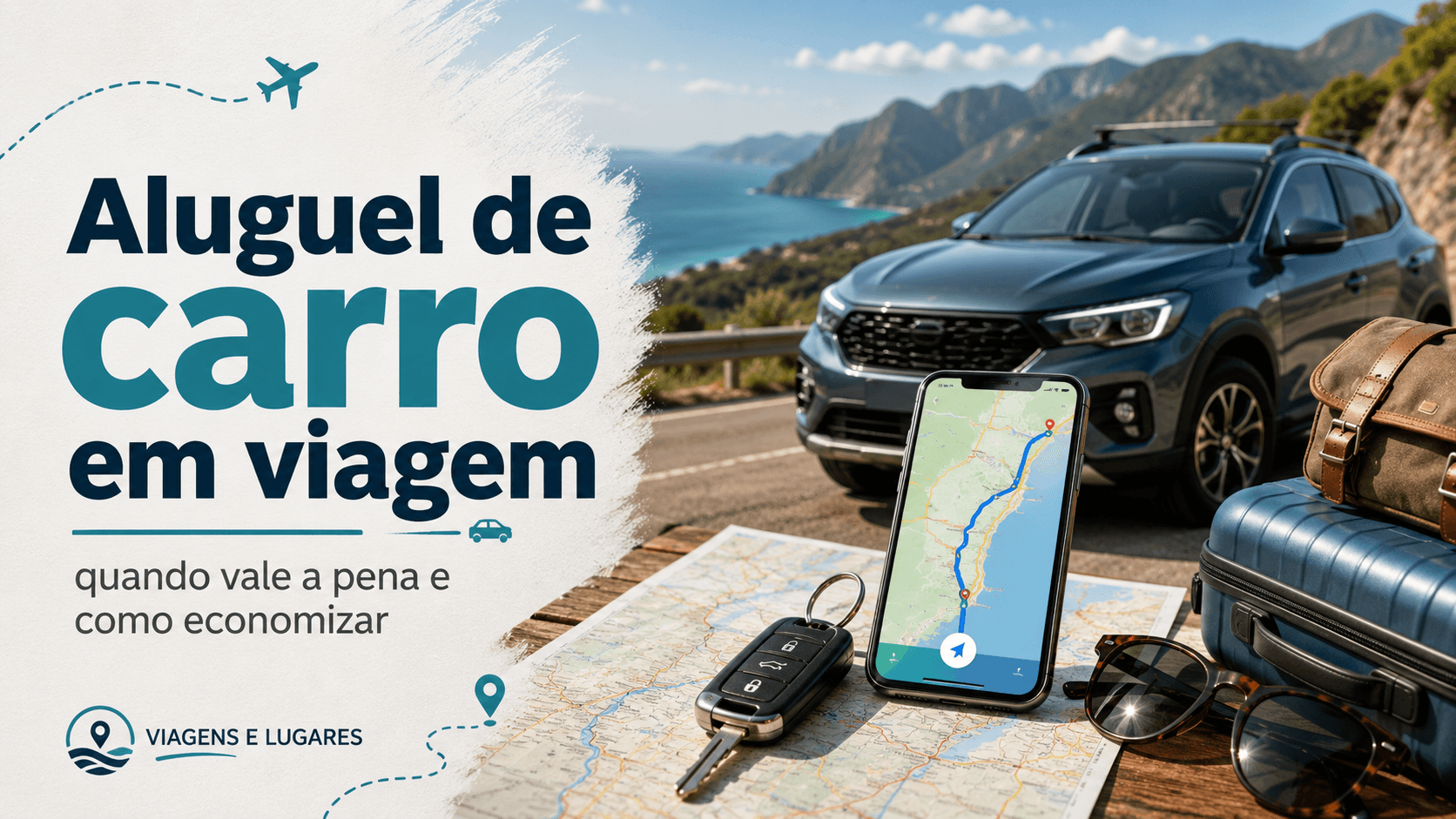
Renting a car for your trip can be one of the best decisions you make — or a completely unnecessary expense. It all depends on the destination, the distances between attractions, parking prices, the number of people travelling and the experience you want.
In some places, renting a car gives you the freedom to explore remote beaches, viewpoints, nearby towns, parks, wineries and restaurants outside the centre. In others, traffic, restricted zones and parking costs turn it into a headache.
In this guide from Viagens e Lugares, you will learn when renting a car is worthwhile, how to compare rates, which extra costs to look for, what protection to consider and how to avoid common mistakes before booking.
Is renting a car for your trip worth it?
It is worthwhile when a car improves your itinerary, saves time, makes getting around easier or lets you visit places that would be difficult to reach by public transport.
Avoid renting a car automatically when the city has good public transport, attractions close together, expensive parking, heavy traffic or strict vehicle access rules.
At a glance
- Best for: road trips, remote beaches, mountain areas, parks, wineries, small towns and family holidays.
- May not be worthwhile: city centres with efficient metro systems, heavy traffic and expensive parking.
- Before booking: compare daily rates, protection, deposits, fuel, mileage, tolls and pick-up locations.
- Common mistake: looking only at the daily rate and forgetting the extras.
When does renting a car make sense?
Renting a car makes most sense when your itinerary depends on being able to move around freely. This is particularly true in destinations where attractions are far apart or public transport does not reach them easily.
- You want to take independent day trips.
- You will visit beaches, viewpoints or parks outside the centre.
- You are travelling with children, older adults or lots of luggage.
- You will share the cost with two or more people.
- Ride-hailing services or taxis are scarce at your destination.
- You want to leave early and return on your own schedule.
- You are planning a road trip.
Before deciding, put together your full itinerary. This helps you work out whether you will use a car every day or only for part of the trip. Also see our guide to planning a trip.
When is renting a car not worth it?
In many large cities, a car can be more of a hindrance than a help. If your destination has a metro, trains, efficient buses, nearby attractions and plenty of ride-hailing options, you may be better off without a rental car.
It is also worth reconsidering a car if your hotel charges high parking fees or the historic centre has narrow streets, restricted zones and few parking spaces.
- You will stay only in the city centre.
- Your hotel charges a lot for parking.
- Attractions are close to metro or train stations.
- Traffic is heavy.
- There are restrictions on tourist vehicles.
- You do not feel comfortable driving outside your own city or country.
To compare alternatives, also read our guide to getting around while travelling.
What should you compare before booking a car?
The lowest price is not always the best deal. A cheap daily rate can become expensive once you factor in protection, deposits, fees, limited mileage, fuel, tolls and an additional driver.
- Final price: check the total booking cost, not just the daily rate.
- Mileage: check whether it is unlimited or capped.
- Vehicle protection: see what is included and what is excluded.
- Security deposit: confirm the amount that will be held on your card.
- Fuel: understand whether you must return the tank full or at the same level.
- Pick-up location: the airport may be convenient, but it is not always cheaper.
- Timing: delays can lead to extra charges.
- Additional driver: there may be an extra fee.
- Returning in another city: this usually increases the price.
Should you pick up the car at the airport or in the city?
Airport pick-up is convenient, especially if you plan to head straight out on the road. However, that convenience may come with higher rates.
For some trips, it is worth comparing three options:
- Pick up at the airport as soon as you arrive.
- Travel to your hotel without a car and pick one up the next day.
- Rent only on the days you take day trips.
If you are spending your first few days in a large city, it may be better to leave the car until later. This avoids paying rental and parking costs while you are still sightseeing in the city.
Which car category should you choose?
The right car depends on the type of trip. The cheapest model is not always the best. A small car can be great for a couple and city driving, but less suitable for a family with large suitcases or mountain roads.
- Economy: good for couples, city driving and short trips.
- Compact: a balance between price and comfort.
- Saloon: better for luggage and longer drives.
- SUV: useful for families, large suitcases and longer journeys.
- Automatic: may be more comfortable, especially abroad.
Rental car protection: what should you check?
This is one of the most important parts of a booking. Rental car protection varies by company, category, country and rate. Read the terms before accepting or declining any extras.
- The excess or deductible payable if the car is damaged.
- Theft protection.
- Third-party coverage.
- Windows, tyres and mirrors.
- 24-hour assistance.
- Contract exclusions.
Rental car protection is not the same as travel insurance. They are different products serving different purposes.
Card deposits: check your available credit
Many rental companies place a security deposit hold on the driver’s credit card. This is not a final charge, but the amount must be available within your credit limit.
- The approximate deposit amount.
- Whether a credit card is required.
- Whether the card must be in the driver’s name.
- How long it takes for the hold to be released.
- Whether digital or international cards are accepted.
For international trips, it can also help to organise payments in advance. See our guide to global accounts for travel.
Fuel, tolls and parking
These costs are often overlooked when comparing rentals. Depending on your itinerary, however, they can take up a significant part of your budget.
- Fuel: calculate the total distance of your itinerary.
- Tolls: check for automatic charging or a mandatory toll tag.
- Parking: check prices at your hotel and attractions.
- Paid street parking: a local app may be needed in large cities.
- Fines: read the speed and traffic rules.
Mobile internet is very useful for maps, tolls, parking and communicating with the rental company. Also see our guide to international SIM cards and eSIMs.
Renting a car in Brazil
In Brazil, renting a car often makes sense for trips to remote beaches, mountain areas, historic towns, natural parks and itineraries involving many journeys.
- Coastal itineraries.
- Trips to mountain regions.
- Cities with widely spread attractions.
- Family trips.
- Destinations with limited ride-hailing services.
On the other hand, in state capitals with heavy traffic, public transport, ride-hailing or specific organised tours may be better options.
Renting a car abroad
Extra care is needed abroad. As well as the price, check driving licence rules, which side of the road to drive on, tolls, parking, restricted zones and the rental company’s requirements.
- Whether an International Driving Permit is required.
- The minimum rental age.
- Young driver fees.
- Rules for crossing international borders.
- The car’s transmission type.
- Requirements for a card in the driver’s name.
- Local parking rules.
If you are still choosing your destination, see our guides to travel destinations and cheap flights.
Checklist before driving away
- Photograph every side of the car.
- Record a video showing scratches and dents.
- Check the tyres, windows, mirrors and spare tyre.
- Check the fuel level.
- Confirm the starting mileage.
- Test the lights, air conditioning and windscreen wipers.
- Keep the contract and receipts.
- Confirm the return location and time.
Tips for saving on car rental
- Book ahead during peak season.
- Compare airport and city pick-up locations.
- Avoid renting for days when the car will sit unused.
- Choose a suitable category, not necessarily the cheapest.
- Check for additional driver fees.
- Avoid returning in another city unless necessary.
- Read the fuel policy before driving away.
- Compare the total cost with public transport, tours and ride-hailing.
Common car rental mistakes
- Booking based only on the daily rate.
- Forgetting the card deposit.
- Not checking protection and the excess.
- Ignoring parking costs.
- Choosing a car too small for your luggage.
- Not photographing the vehicle at pick-up.
- Returning outside the agreed time.
- Not reading the toll and fuel rules.
Frequently asked questions
When is renting a car for a trip worthwhile?
It is worthwhile when a car makes your itinerary easier, saves time or lets you visit distant attractions. In cities with good public transport, heavy traffic and expensive parking, it may not be worth the cost.
Is it better to pick up the car at the airport?
It depends. Airport pick-up is more convenient, but not always cheaper. Compare the total price with city branches and consider whether you will actually use the car from day one.
Do I need extra protection for a rental car?
It depends on the rate and the protection already included. Before deciding, check the excess, deposit, coverage, exclusions and assistance. Do not accept or decline extras without understanding the contract.
Is renting a car better than using ride-hailing apps?
It depends on your itinerary. A car can be worthwhile for frequent long journeys. For a few trips in a large city, ride-hailing or public transport may be cheaper and more convenient.
Key takeaways
- Renting a car is worthwhile when it improves your itinerary.
- Compare the final price, protection, deposit and fuel.
- Avoid driving where traffic is heavy and parking is expensive.
- Photograph the vehicle at pick-up and return.
- Check local rules before driving abroad.
To keep organising your trip, also see our guides to trip planning, travel insurance, international SIM cards and travel destinations.
Disclosure: some links in this post may be affiliate links. Viagens e Lugares may earn a commission if you book through them, at no extra cost to you.
About The Author

